
My Epiphany
Finding common ground with a teenager pulling away

As I picked him up from a friend’s house last night, my son refused to talk to me. He said a few words, but I begged him to tell me about his day, explaining, “I don’t know them, and by sending you to someone’s house I am offering my trust.”
I just want to know what his new friend and her family are like. But instead of answering the simple questions, he shut me down with short, one-word answers: Good. Fine. OK.
So, I asked more specific questions, to which he said he didn’t want to talk, and after I pressed him a tad more, he said, “We just don’t have anything in common.”
He wasn’t talking about them. He was talking about me.
Later, he said he wasn’t trying to be unkind. He was being matter of fact, which somehow hurt more. When I asked him what he meant, one of the examples he offered was simple: I like art. He does not.
His words made me feel that familiar parental mix of defensiveness and grief rise up, as I realized I was suddenly being dismissed by someone I once knew better than anyone else. So, I did what some of us do when something lands on the bone: I snapped.
I used very few words, but my instincts made sure it hurt. I don’t want to say them ever again, but they’re the kind of words you say when you’re startled by the idea that the distance between you and the person you love—in this case, my child—might be wider than you realized. In that moment, the hurt that flew from my mouth was my way of reaching for shared ground—surely we still live in the same moral universe?
Parenting a teenager is the most difficult experience. And why can’t they all be the same? I can love him ferociously and still feel, on some nights, like he hates me. Or worse—that he’s already begun to write me off as irrelevant.
He’s in the middle of pulling away, figuring out who he is by not being me, pushing back on anything that feels too close or too familiar. I know this intellectually. It still hurts.
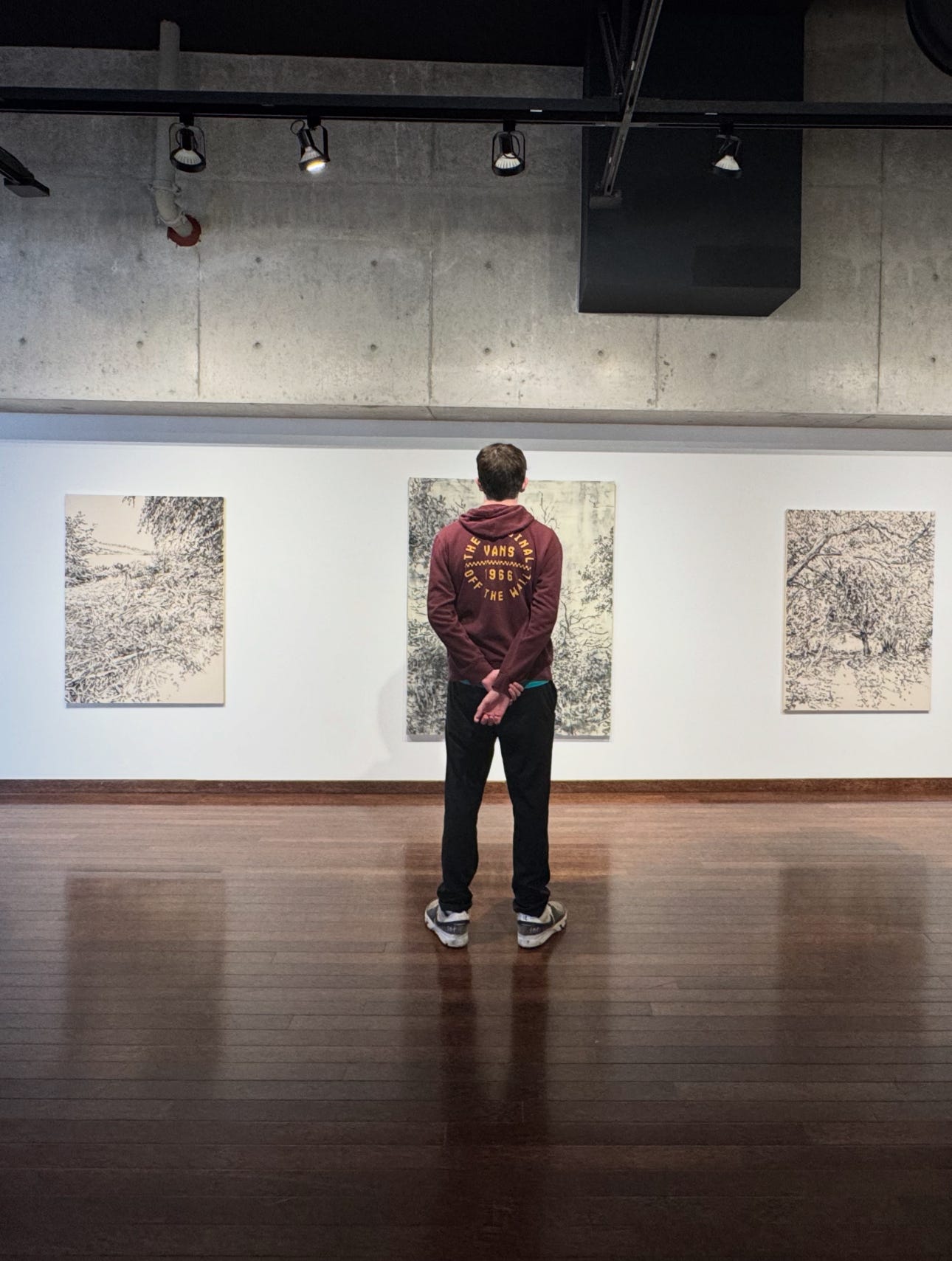
After I went to bed, I kept thinking about that comment. Not because I need him to like galleries or paintings or the things I’m drawn to, but because it forced me to think about what it actually means to have something in common with someone, and how do I articulate that to him?
I guess we often think of the concept as shared preferences: same interests, tastes, and ways of going about the world. But that definition falls apart quickly across generations, especially between a parent and a child whose job, developmentally, is to become not you.
His words also made me think about what art actually is to me, and how I think he’s one of the most creative people I know.
Art, for me, isn’t about refinement or status. It’s also not about museums, though it can live there. It’s a human practice, and it’s one of the oldest ones we have. I think he has brilliant ideas and is an excellent writer. Before written language, we had marks on cave walls. Before formal belief systems, we had images, rhythm, and stories told through oral tradition.
Art is how we make meaning. It’s also how we leave evidence that we were here.
Art records who we were at a moment in time. It tells a story about what we feared, valued, found beautiful, what we were willing to protect. It preserves culture, yes, but it also preserves feeling. The art we are drawn to—fashion, books, buildings, food—tells others what we are about, what we have access to, and where we come from.
And that’s where I think my son and I might actually meet. Because art isn’t confined to frames or stages. It shows up wherever people try to understand the world and their place in it. It’s in how someone builds something, solve problems, design systems, argue for fairness, or care deeply about how things work.
Art, at its core, is attention.
It’s noticing enough to respond to something internal—confusion, anger, joy, curiosity—and giving it form. That form might be a painting. Or it might be a solution. Or a structure. Or a conviction.
Even people who say they “don’t like art” are often already practicing it. They just use different tools.
Last night didn’t end neatly. There were sharp words that landed wrong, and moments where we both felt misunderstood. That’s part of this season, too.
But by the end of the evening, we did something important.
We apologized for the things we said poorly. We acknowledged that we’d hurt each other. And we made sure, explicitly, to say, “I love you.”
And that is something we absolutely have in common.
Not shared hobbies. Not identical interests. But the willingness to come back to each other. To repair. To name love, even when it feels strained or awkward or earned only through effort.
I think to have something common isn’t about liking the same things at all. For me, it’s about sharing the same underlying instincts to connect, to mean something to each other, to keep showing up, even when we just threw daggers at each other. Even when it’s hard.
And that is an art form in its own.
I had a terrible exchange with our teenage son. My husband and I became his and his brother's guardian. Suddenly parenting two teenagers at 15 and a 16 years old. As I sort of hovered over him, we ended up watching fishing YouTube videos together without saying anything about the conflict. Before we quit he said, "This summer, I want to help you catch the biggest fish you've ever caught." It happened that summer. I think we have a photo of it somewhere. This post reminds me I need to write about that sometime. When he shared that unsolicited summer goal, I knew he was telling me without telling me that he still wanted me in his life. I'm thankful I had the wisdom to just listen and accept the gift without further comment. When I pulled in that 5 lb bass, I reminded him that he'd told me he was going to make it happen and how thankful I was that he had.
The most challenging aspect of parenthood is providing protection vs grantimg independence. With grace & compassion we all eventually get thru it. I'm a Dad of 3 grown up kids & relearning these lessons as a grandpa!