
Can We Care Without Conditions?
What a workplace conversation revealed about how we see each other

Yesterday, a coworker asked me a question that highlighted a problem. The question wasn’t the problem. The problem was what it assumed.
“What do you think about them moving polls into mosques?” she asked.
This was the question of a seemingly educated and otherwise kind 30-something year old woman, who overheard me give election reporting as an example of data collection when I was talking about working on my master’s in data analytics.
On the surface, it might sound like curiosity to some, but to me displayed a quiet premise: that a mosque is somehow different. I gathered from her question that she considers a mosque riskier. Less appropriate than Salem Lutheran, Trinity Evangelical Lutheran, and Crest Baptist churches in Creston that have been serving as polling location for years without anyone batting an eye. That’s the problem.

I had walked over from the lab because I heard what I thought was torrential rain. A few nurses were already gathered at the station, some working, some talking about the weather like people do when they need a breath between tasks.
As we made small talk. Someone asked what I was studying, and I said I was finishing my master’s in data analytics. I stated my past as a journalist, volunteer water sampling for the Isaac Walton League, and work as an election night reporter and poll worker as examples of data collection that has piqued my interest through the years. I’m all for the kind of work that is about collecting information, not spinning it. It felt appropriate to answer a question about school because data also relates to my job.
So when a question about my opinion on moving polling locations to the inside mosques came up, I paused because I was trying to understand why it needed to be asked at all.
“Well,” I said, “the Lutheran church in Creston is a polling place. Why wouldn’t a mosque be?”
That should have been enough. Polling locations are chosen because they are accessible, familiar, embedded in a community. Churches, schools, community centers. Buildings large enough. Polling locations are about proximity, not theology.
“But Muslims want to kill Christians,” she said.
I took a deep breath and realized her original question wasn’t really the point. I knew what was happening. I then pointed out that in every religion and group of belief; there are extremists and bad actors. It’s a spectrum.
Another nurse stepped in almost immediately.
“What do you think about Sharia law? how about clitoridectomies?” she asked.
I started to boil inside. And then, without giving me time to respond or to shut this shit down, she launched into a story, a single, disturbing anecdote about a patient somewhere else, in another state, something about threats and harm, something meant to stand in for an entire faith. In a matter of seconds, we had moved from a question about civic access to a conversation rooted in fear.
“That’s not what she asked me,” I said.
I was trying to point back to the original question, trying to anchor us there, but the shift had already happened. Someone else walked up, and I used it as an exit because in the few minutes this all went down, I probably had a patient to get to and, frankly, because I could feel the weight of the room leaning in one direction and I was alone in mine.
What I continue to learn when I talk with people, at work and in my community, is that we are TERRIBLE at scale. We take one story and stretch it over millions of people. We take the most extreme example and let it define the whole. It feels efficient and protective.
It is neither.
Most of what I know about practicing faith is from being raised in a Christian one. But I also studied political science and world religions and have Muslim friends (including a former roommate). I’m not calling my coworker a Christian Nationalist, but her question is rooted in fear, and her understanding of the Islamic faith is missing this fact: Most Muslims hold a deep respect Jesus and hold him as one of the greatest prophets and the Messiah, and he holds a central place in Islamic belief. They even believe in his virgin birth and have an entire chapter of the Quran dedicated to Mary.
And damn sister, I don’t have time to write a dissertation about Sharia Law, clitoridectomies, my feminist views or fondness of sexual pleasure. Nor is it your business.
But as I walked back to my desk, my inner voice is screaming: Islam is practiced by nearly two billion people! That number alone should force a pause in anyone. No group that large can be reduced to a single narrative, just as no group that large can be entirely good or entirely bad.
Why do we understand this instinctively when it comes to ourselves?
I think it’s safe to say, most Christians I know do not want to be defined by extremists who use faith to exclude or harm. We push back against that framing because we know it’s incomplete and unfair. So, it’s worth asking:
Why we are so willing to extend that same unfairness to others?
I wasn’t raised in a monoculture. I was baptized Catholic, yes, but I grew up in San Diego alongside Muslims, Jews, and Hindus. My friends, my neighbors, my version of “us” has always included people who believe differently than I do. No one was trying to take anything from me. No one was plotting to replace anything sacred. I never feared being poisoned by my devout Muslim roommate or feared what her friends would do to my daughter when left in her care. We were just living, going to school, sharing meals, and figuring out who we were.
When I hear a question like that, I can’t help but wonder when we started believing that proximity equals threat. When did we decide that a building becomes suspicious because of who prays inside it? When did we get so comfortable letting fear fill in the gaps where understanding should be?
And here is where the setting matters. This didn’t happen online. It didn’t happen in some anonymous comment thread. It happened in a hospital, a place where people come at their most vulnerable, where they do not have the luxury of wondering whether the person caring for them sees them as fully human. If bias shows up casually in conversation, it doesn’t stay contained. Others feel it, whether we admit it or not.
It makes me wonder, if we are comfortable questioning someone’s place in civic life, are we also, even subconsciously, questioning their place in our care?
I didn’t argue or lecture because I know it would have fallen on deaf ears. I answered what was asked, I tried to redirect when the conversation shifted, and then I left when I could without being rude. And if they weren’t my coworkers I would have walked away sooner.
I’ve been up since 3 a.m. and thinking about it ever since. Not just what was said, but what sat underneath the words said. And as caregivers, what they think about me as a human.
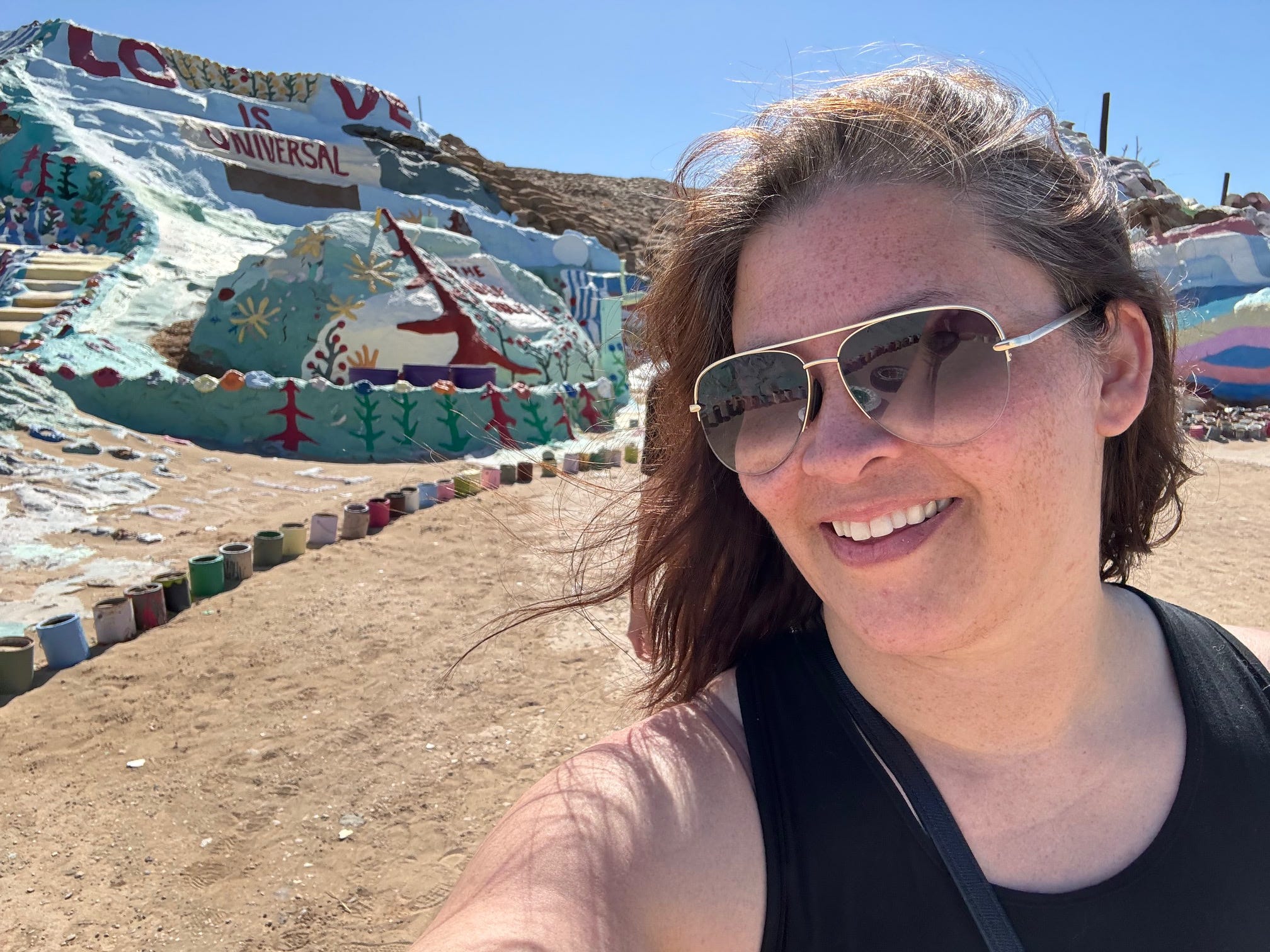
Hello, I’m Sarah Scull, a former journalist and proud member of the Iowa Writers’ Collaborative.
If you want to know what Iowa actually sounds like right now, follow the weekly roundups from the Iowa Writers Collaborative. We do what newspapers rarely can anymore: move easily from politics to poetry, from sports to sharp human stories, capturing the full, complicated life of the state in one thoughtful sweep. It’s Iowa, reported and reflected by people who live here and pay attention.
Also, five kids in rural Iowa could use your support.
Brava, Sarah! Thank you for a calm, well thought out response to this disturbing question, and more disturbing trend in the country. I lived in San Diego for 14 years, and like you, enjoyed the multicultural experience. I’m Catholic too (that’s how I met your mom and dad), but I’ve never considered someone’s religion as criteria for friendship. I’ve worked for doctors who were Christian, Jewish and Hindu. I guess I just never thought about it. I’m nowhere near as articulate as you, but I hope I’m able to respond as clearly should that situation come up.
Sarah, thanks for addressing the issues of generalizations and blanketing social concerns. I’ve been in similar situations; it’s very difficult to converse on facts when social media blogs are being assumed truths. When you come up with some appropriate intercessions, let’s talk! Good piece of writing BTW!!