
A Twist In Time
A student-made dystopian film about Nazi victory, polio, and the human cost of hatred

When I first viewed the short film my son and his friends created for the Technology Student Association national competition in Washington D.C., I was horrified.
In the film, they appeared on screen portraying Nazis and Jewish prisoners. I froze.
The incomplete version of the film I first watched was awarded first place in digital video production at the state TSA competition, and qualified for nationals. However, all I could think was: Absolutely not. There’s no way this lands correctly with strangers. I can’t end up on KCCI.
I never read the original pitch, film notes, nor did I participate in the writing process, therefore I didn’t understand the context. As it was, half finished, I didn’t understand the message. More than that, I knew I didn’t feel comfortable showing it to another human being without explanation. So, I did what anxious mothers (who also used to work in journalism) do: I started asking questions.
I first showed his father and then contacted the student advisor teacher, to ask about it and for a copy of the rubric. I also reached out to their former STEM/language arts instructor, who viewed the film, and asked what she thought the judges saw. What was I missing?
Eventually, after learning about the concept and project goal, it became clear.
With a competition theme, “A Twist in Time,” the students imagined an alternate future in which Nazi Germany had won World War II. Suddenly, the imagery made sense.
But even then, I knew the story needed more. Not because the students lack talent, but because difficult subject matter demands precision. As a former news reporter, I learned that audiences don’t always enter a story carrying your intent or basic understanding with them. They interpret the story with their own experiences, assumptions, fears, and blind spots. If something is unclear, they tend to fill the gaps themselves.
So, the students kept thinking. And what they ultimately came up with was surprisingly thoughtful.
The revised film asks a simple question:
What disappears when an entire people are eradicated?
The students chose to center the story around polio. In their reimagined storyline, the disease continues devastating the world because the scientist responsible for developing the first effective polio vaccine never survives.
Note: The students chose polio largely because it is a widely recognized disease, and because – as teenagers who lived through COVID – pandemics feel immediate and understandable to them in a way previous generations of students may not have experienced. They also understood that the creator of the vaccine, Jonas Salk, was Jewish, which connected symbolically to the film’s broader question about what humanity loses when entire groups of people are targeted or erased.
Historically, the scenario is not meant to function as a literal alternate timeline. Salk was born in the United States, and the vaccine was developed in the 1950s, after World War II. The students chose polio as a simplified narrative device rather than a precise historical prediction. Their larger point was about the unseen human cost of hatred, intolerance, and authoritarianism, which includes the discoveries, compassion, creativity, and progress that can disappear along with the people themselves.
The film ends with the line:
“You can eradicate an entire people or population, but at what cost?”
And there it was. Not shock for the sake of shock, but consequence.
Living with Intention
Jonas Salk, who created the first polio vaccine, has always mattered to me, though probably not in the way people assume.
I grew up in San Diego, where biotechnology and medical research were simply part of the atmosphere. My father spent career working in laboratory science. My mother was an OB-GYN nurse. My brother became a pediatrician. Conversations about medicine, ethics, vaccines, and research drifted through our lives so regularly they almost felt environmental, absorbed without effort.
Now, after two decades away, I find myself working in a hospital laboratory again. But long before that – before motherhood, before Iowa, before most of the life I know now – I thought about becoming an architect.
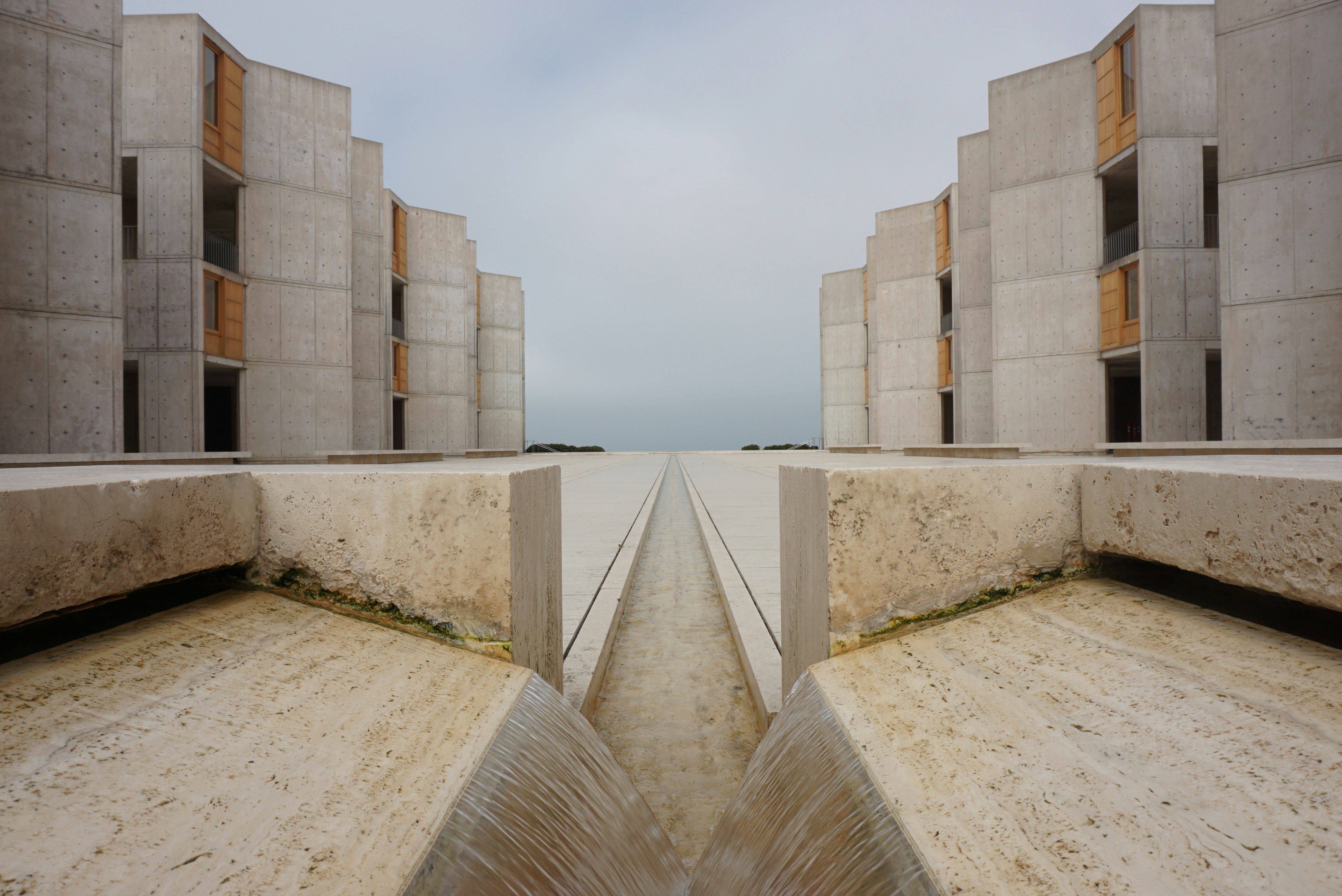
One of the places that stayed with me from that time was the Salk Institute, designed by Louis Kahn for Salk himself.
What moved me about Kahn’s work was his restraint. He designed with an almost spiritual level of intention, where light, silence, concrete, water, and open space mattered just as much as the scientific work and experience taking place inside.
Watching the student film stunned me. It reminded me of the first time I brought my son Fletcher to the Salk Institute. He was just 4-years-old.


At Salk, Fletch was fascinated by the narrow water feature that cuts through the center courtyard. I remember him clutching his stuffed “Sharkie” under one arm while leaning carefully over the channel, trailing his fingertips through the rushing water as it disappeared toward the sea.
I tried explaining to him how the movement of the sun changes the appearance of the water throughout the day and how light shifts across the concrete and makes the stream of water look almost alive as the hours pass overhead.
I like to think he understood what I meant or at least felt the wonder I was trying to describe. But honestly, he was more concerned with the possibility of dropping his shark in the water and growing anxious at the idea of it ending up in the ocean.
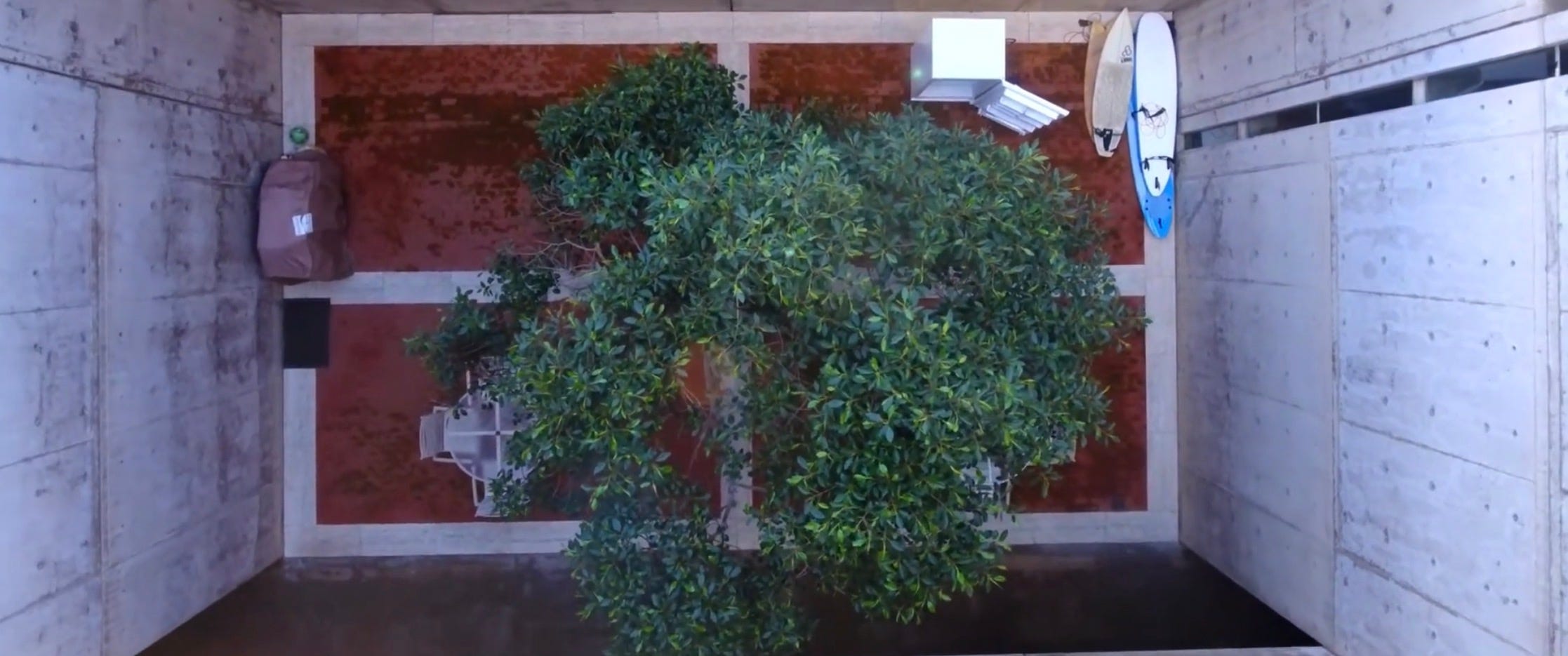
I brought Fletcher back to the Salk Institute in 2019. I pointed out the surfboards outside an office.
“Maybe someday you’ll work here,” I said.
Third grader Fletch was just as disinterested as he was years prior. However, he has since learned to surf.
With Fletcher, I have always encouraged scientific rigor and with the understanding that science and human life are not opposing forces. I’ve always wanted my children to pursue excellence, curiosity, and discovery, but never at the expense of wonder, compassion, rest, relationships, or the ability to sit quietly beside the ocean and feel the entire force of the universe.


What We Do with Great Power
Salk stands out to me because he famously refused to patent or to directly profit from the vaccine he created.
When asked who owned the patent, he reportedly said, “Well, the people, I would say. There is no patent. Could you patent the sun?”
As I guided my son toward the sciences, Salk’s personal ethos was one I hoped would shape the kind of person he became. Not because I believe scientists should work without compensation, or that innovation exists outside economics. I just desperately wish for more people who understand that human advancement carries moral responsibility alongside achievement.
Yesterday, after watching the final version of the students’ film, I called Fletch and casually asked if he remember who developed the polio vaccine?
He paused and admitted he forgot.
I appreciated his answer because the point to everything he’s been exposed to or taught isn’t about memorization. It’s that these kids, at 15, are asking the right kinds of questions.
What happens when power loses its humanity? What do we owe one another? Who gets erased when hatred wins? What responsibility comes with knowledge and innovation?
These are not small questions. And frankly, as future engineers, drone operators, coders, researchers, and technologists, I hope they continue asking these questions.
The students in the Creston Engineering & Innovation Club are not sitting in a classroom following step-by-step instructions. They are building things themselves. Testing ideas. Solving problems. Revising failures. Leading one another. And yes, arguing with each other. Sometimes succeeding spectacularly. Sometimes making choices that alarm their parents before eventually revealing unexpected depth.
In other words, they are practicing becoming adults.
I am not at all interested in intelligence without ethics. History is full of brilliant people who built systems that harmed humanity because they stopped asking moral questions somewhere along the way.
Technical skill alone is not wisdom. Of course we need coders and engineers and people willing to solve difficult problems, but I hope the people building the future are also deeply compassionate.
As parents, I think most of us hope our children will pause long enough to consider consequences – that they will understand just because something can be built does not always mean it should be, and that progress without compassion becomes its own kind of danger.
And this is why this strange little student film stayed with me. Because underneath the dystopian imagery and alternate-history storyline, I recognized something hopeful.
These kids are not fantasizing about power. They are asking what happens when people forget the value of other human beings.
Learn more about their upcoming competition in the Creston News Advertiser here.
Hello, I’m Sarah Scull, a former journalist and proud member of the Iowa Writers’ Collaborative.
If you want to know what Iowa actually sounds like right now, follow the weekly roundups from the Iowa Writers Collaborative. We do what newspapers rarely can anymore: move easily from politics to poetry, from sports to sharp human stories, capturing the full, complicated life of the state in one thoughtful sweep. It’s Iowa, reported and reflected by people who live here and pay attention.